H2O2 signaling disruption as a new framework for Alzheimer’s disease
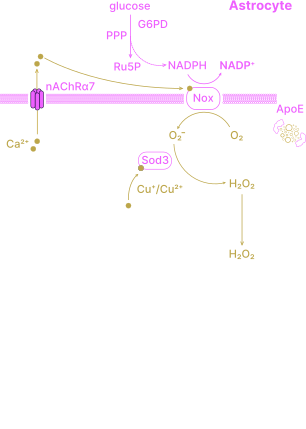
We recently discovered a new neuron-astrocyte coupling mechanism that is active during memory formation. In brief, cholinergic neurons activate astrocyte synthesis of beneficial reactive oxygen species. In turn, neurons import H₂O₂, which triggers an oxidoreduction cascade that sustains long-term memory formation. We named this pathway Astrocyte-to-Neuron H₂O₂ Signaling (ANHOS), and it critically depends on APPL, the Drosophila homologue of APP.
More specifically, the release of acetylcholine (ACh) by neurons in the LTM brain centre increases calcium influx in astrocytes via α7 nicotinic acetylcholine receptors (α7nAChR), which triggers the production of extracellular O₂⁻ by astrocytic NADPH oxidase (Nox). Superoxide dismutase 3 (Sod3), activated by APPL-released copper, then converts O₂⁻ to H₂O₂, which is imported into LTM-encoding neurons. We have identified a new major role for APP in memory formation: delivering copper to astrocytic Sod3.
Strikingly, ANHOS is completely blocked by the human Aβ42 peptide, a key factor in AD. Artificial secretion of human Aβ42 by long-term memory neurons inhibits astrocytic α7 nAChRs. Based on this discovery, we propose exploring the disruptive hypothesis that AD originates from a lack of H₂O₂ signalling in cholinergic neurons.
Our strategy is to set up a comprehensive programme to explore the role of ANHOS in physiology and demonstrate its involvement in early molecular and cellular dysregulation leading to AD, using Drosophila and mouse models. Our ultimate goal is to identify new ways to mitigate AD defects.
Several of the questions we wish to answer in order to pursue our line of research into Alzheimer’s disease are outlined below.

Our results suggest that the transfer of copper ions from APP to Sod3 plays a central role in sustaining H₂O₂ synthesis and long-term memory formation. What mechanisms govern this transfer? Does APP interact physically with Sod3? Is this copper transfer stimulated by long-term memory formation? Given that copper dyshomeostasis is observed in AD, our research could have important implications.

Early glucose hypometabolism is evident in the preclinical stage of AD, but its origin is still being debated. In view of the significance of glucose oxidation in Drosophila memory formation in both neurons and glia (de Tredern et al., 2021; Rabah et al., 2023; Rabah et al., 2025), our objective is to explore whether and how ANHOS impairment results in a reduction in glucose flux during long-term memory formation. Our expertise in in vivo glucose imaging, combined with precise genetic targeting, should be instrumental in deciphering the regulation of glucose fluxes in Drosophila AD models.
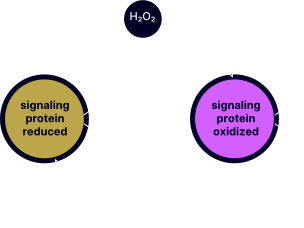
From a physiological perspective, which molecular pathways are transiently activated by H₂O₂ during the formation of long-term memory? Once these pathways have been identified, could some of them be stimulated to counteract the negative effects of Aβ42 on memory formation?

The APOE4 allele is the major genetic risk factor in AD, being found in around two-thirds of patients with the disease. APOE is mainly expressed by astrocytes and is involved in lipid transport. Does APOE4 interfere with ANHOS, and if so, what mechanisms are involved? Do Aβ42 and APOE4 differ in their interaction with ANHOS?
One of our primary objectives is to demonstrate that the ANHOS cascade is conserved in the mammalian brain and to examine the impact of its impairment by Aβ42 on synaptic plasticity. We will achieve this aim through close collaboration with Dr Hélène Marie (IPMC, Valbonne, France).